It’s four in the morning and I have a decision to make. Do I:
- Get another hour of broken sleep before my six-week old baby opens her pink throat wide or another feed, or;
- Carefully prise open the laptop lid and work on the words in my head that are begging to be written?
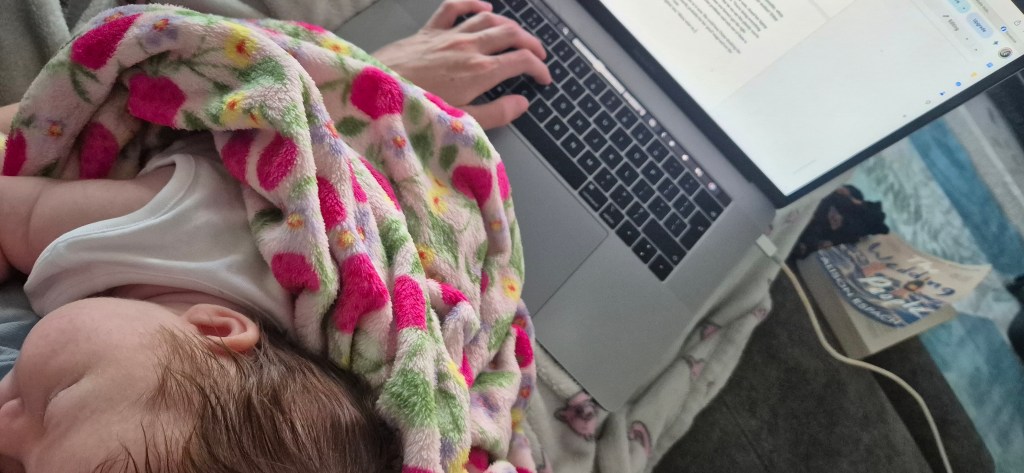
I glance over at the baby; she’s in deep sleep now, her tiny moon-fists gently punching the air; feet wriggling beneath her wool blanket. She makes a small grunt and settles again. I look at the pile of cushions and thin blanket on the sofa beside her moses basket and then I yawn, pulling the laptop slowly from its place from the side table.
I’m going to write. I rub my eyes and start.
Sleep when the baby sleeps, write when the baby writes?
Ever been told to “sleep when the baby sleeps”?
When a newborn finally sleeps, it’s very much like the fraught tension before someone decides to drop something very breakable and very loud onto a tiled floor. You sit very still, watching (sometimes for hours). You do not move the muslin cloth six inches to the left in case the scrape of fabric on fabric undoes the whole fragile arrangement. But when you finally realise that there is no waking this tiny, dreaming child, with her full belly rising and falling beneath her sleepsuit, a thought occurs to you: I could write something.
Before the baby arrived, people were keen to tell me that newborns sleep eighteen hours a day. Even if she’s awake at night, I could simply synchronise my naps with hers. And so, naturally, I had romantic ideas about when writing would happen. Dawn, probably. Or maybe late at night, in a pool of lamplight, with a cup of tea gathering a skin on it beside the laptop, because that’s how it looks in the films, doesn’t it?
However, I have quickly learned that every baby is different. Some babies, like my dear Anwen, have days on end where they simply will not nap at all. Nights are spent bringing the baby to my breast, then releasing her again. Then I must wind her, change her (sometimes multiple times in a row), sterilise pump parts and bottles, rock her, shush her and nod off on the sofa before the whole cycle starts again.
By six in the morning, her blue eyes are startlingly wide, her hands opening and closing like starfish. She’s begging to be held and my partner starts work at eight. I look down at the baby thrashing in my arms, wanting to be entertained, or fed, or carried around the house propped up on my shoulder. We are in for a long day. That idea I had for a writing project while I was cautiously stirring milk into my tea at five in the morning will have to wait.
Sleep when the baby sleeps? Occasionally I’ll get fifteen minutes in the day (forty minutes if I’m lucky and the moon is in the correct house). A few weeks ago, I got four hours, which felt so abundant I didn’t even know what to do with it because I was too busy watching over her for any signs of distress. This isn’t just me being dramatic about my own exhaustion, either; one 2025 study tracking first-time mothers found their average daily sleep fell to 4.4 hours in the first postpartum week, down from 7.8 hours before pregnancy, and their longest unbroken stretch of sleep dropped to 2.2 hours, from 5.6. It was one study, of one group of new mothers, but it went some way towards explaining why, when a genuine two-hour window finally arrives, the brain doesn’t quite know what to do with such uncharted abundance.
Certainly not writing.
I’ve quickly learned that there simply is no good time to write. It’s up to me to find this time when I can.
However, when you’re six weeks postpartum and must put this tiny, helpless human’s needs before your own, trying to do this without guilt becomes near-enough impossible.
Motherhood and writing: the highlight reels
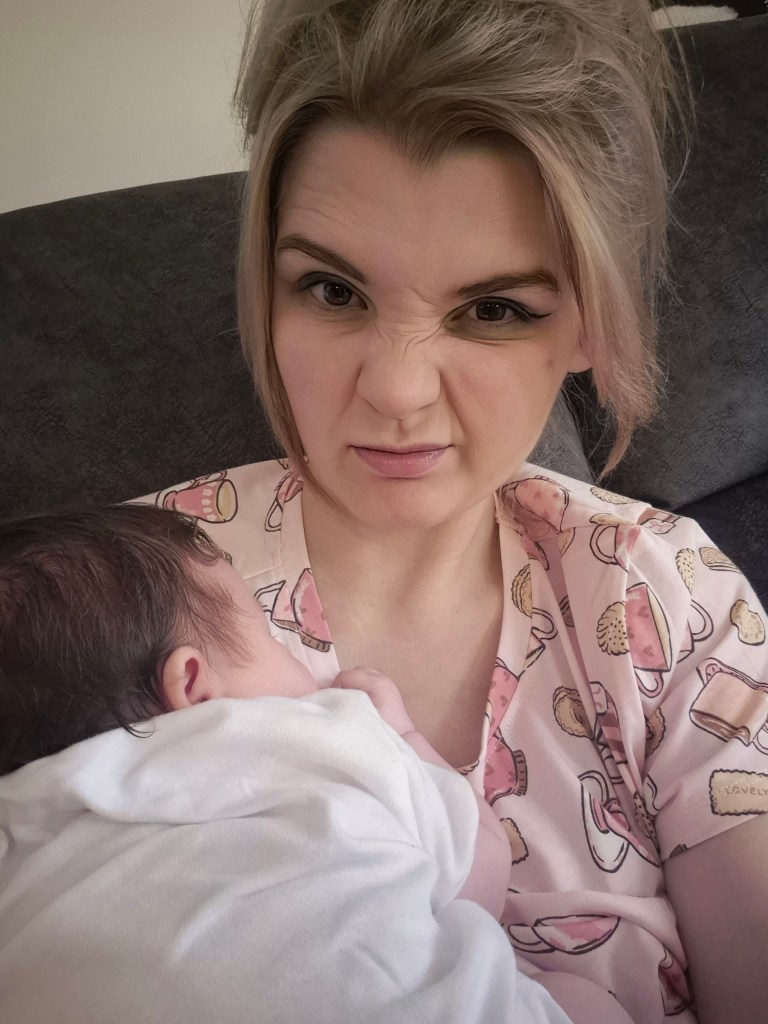
Someone recently told me that they were surprised that I felt like I was struggling sometimes because “you make motherhood look easy”. I realised that they were referring to my social media posts which, of course, I’ve curated to make sure I’m only ever showing the highlights.
This is the same for writing. If I’ve won a writing competition or have a new book about to be launched, I want to share this success. If I receive a rejection (or, more recently, many rejections), into the trash folder it goes, never to be mentioned again. It’s the same thing for motherhood; if my daughter is smiling in adorable outfit, then that feels safe to show people because it means I’m handling things well. Never does it even cross my mind to set up my camera to record when the baby’s crying and I’m crying, and neither of us can work out a solution. Never do I consider sharing that I’m still reeling, six weeks later, over a birth experience where I get flashbacks and nightmares almost constantly. Six weeks means you’re recovered! You can drive again! You’re okay now!
I should be over it all. I should have my baby in one arm and be typing thousands of words with the other.
Let’s talk about the word ‘selfish’. If we’re going to be totally honest, we know that this is the exact word that hovers on the tongue whenever a mother does something that isn’t directly, immediately and physically in service of her child. Writing, in particular, seems to attract this word because on the surface it doesn’t really look like anything other than pissing about on your laptop. If you’re cleaning, you can point to the clean thing. If you’re cooking, there’s a meal. But writing – thinking, staring into space, typing forty words and deleting thirty of them – looks, to the untrained eye, like doing nothing at all at exactly the moment when you are supposed to be doing something that’s your duty to fulfil.
Nobody asks a father whether it’s selfish to disappear into the shed to work on his car, or to go for a run, or to watch the football with the baby monitor propped on the arm of the sofa. He is “having some ‘me’ time.” When a mother closes a door (or a laptop screen) to attend to a thought that is entirely her own, she’s being selfish. There’s a baby who needs her, after all.
I think there’s a gendered arithmetic at play here, and one where a mother’s time is treated as communal property and a father’s time is treated as…well, his, right? The numbers, when you go looking, back up this gut feeling: an ONS analysis from 2016 revealed that there were 26 hours of unpaid work a week for women against 16 for men (though that data is now the best part of a decade old, and I’d hesitate to treat it as gospel for how things stand today). Still, the gist of it, if not the precise numbers, probably feels uncomfortably familiar to too many people, especially after the partner has returned to work.
Asking for help (even if it feels wrong)
So far, most of my writing has been done at the expense of sleep. I’m 10,000 words into a new novel and I’ve got poems coming out of my ears – mainly to process a huge life transition, but also because my writing is on the cusp of change and I want to let it develop. I know that how I’m writing now is very different from how I wrote a year ago, and certainly from how I wrote ten years ago. I’m keen to see where it goes and afraid of what will happen if I abandon it entirely.
But now there’s a problem: I also want to make sure I’m the best mother I can be to a little girl who’s been the biggest blessing in my life.
Part of being the best mother I can be is tied to feeling fulfilled as a person. Maternity leave has meant I’ve had to shed my identity as a content marketing manager and resist stepping in when notifications pop up on my Linkedin related to our business page when I know full well my colleagues are fantastically capable. I must close the notification, stop formulating a reply to a new comment in my head, and move on. My running shoes are currently in hibernation, with no idea when I can drag them back out (I was given precisely zero information on c-section recovery; I was just handed some paracetamol and dihydrocodeine and ushered out of the postnatal ward with a baby in a carrier, completely overwhelmed). The only thing tethering me to my old identity is my writing. But how on earth do I balance this with caring for my daughter without being a terribly selfish mother?
What I’ve come to understand (albeit slowly and stubbornly) is that when help is offered, you should take it. A family member wants to have the baby for an hour or two? Say yes. A friend has offered to hold the baby while you catch up on things that have fallen behind? Accept it. The help wouldn’t be offered unless it was genuine.
I’ve very easily fallen into the trap of only doing cleaning and laundry when my partner takes the baby out for a few hours. This is not chillout time. It is not writing time. It is time simply doing more domestic work which, to be honest, does not satisfy any part of who I really am as a person – it’s just something that desperately needs doing (how on earth have I managed to splatter tomato sauce over the toaster anyway?).
Some helpful tips on writing as a new parent
So, what does this look like in practice to maintain your writing while still being a good parent? How on earth do you write when you have a newborn who’s clawing at your boob, when your brain feels like mashed potato and when the guilt is sitting on your chest like a Jack Russell who’s trying to clean your nostrils? (Thanks, Ted.)
1. Lower the bar
Firstly, lower the bar so far it’s practically underground. Don’t focus on getting the novel finished; focus on getting the idea down, or the next sentence, or a snippet of dialogue that popped into your head while you were pulling a pee-soaked babygro over your dear child’s head. Use the Notes app on your phone if you need to, or the Voice Record app, or whatever works when one hand is near-constantly holding a baby. Every idea you record and every few words you write is still progress.
2. Use the imperfect windows
You might be used to writing at 7pm with a cup of tea (made leisurely and in perfect silence), but you’re going to accept that this is likely going to change. If your baby is asleep at 2pm on a Tuesday, then that’s your window that day (and be prepared for these times to change daily. Newborns are notoriously unpredictable when they don’t have routines yet). Don’t wait for conditions to be perfect, because they won’t be, and not for years (probably). Work with what you can for now, even if it’s on your phone in the Asda car park.
3. Don’t be afraid to ask for help
It’s hard to shake the feeling that asking for help means that you’re a complete failure as a mother. The more I talk to other mothers, the more I learn that this isn’t true; one of the biggest regrets that they often share is that they didn’t accept help – especially when it’s their first child.
Ask your mother to come round. Accept your friend’s offer to watch the baby with a coffee while you sort yourself out for an hour. Hand your baby over – to someone you trust and someone who loves them – and go sit somewhere and write. This isn’t abandonment or proof that you’re an incapable mother, by the way. On the contrary, it’s you remembering that you are a person with a mind that needs feeding and that feeding your mind makes you a better mother, not a worse one. Your baby benefits from having a mother who feels like herself and who has had a moment to think for herself.
4. Give yourself permission to press pause
I know that not everyone has a village. Not everyone can easily have a break and not everyone has the luxury of a long maternity leave or a partner’s support. Some mothers might have health issues that drain their time and energy. Some have other children to look after too and free time is scarce (you have my utmost respect, by the way). Or maybe, mentally, some days writing just isn’t a consideration at all.
None of this means you’re marking the end of your writing career.
You can give yourself permission to press pause. When the baby cries and you have to stop mid-sentence (again), you’re not a failure. Even if you don’t write another word for three years, you’re still a writer. I’m reassured, by many writer with children, that the writing will still be there when you come back to it. For now, you’re in survival mode. Survival comes first.
The passion for writing, no matter how distant it feels right now, is always within you and it will spark up again.

Who are you, really?
Your identity is made up of many various, unique and beautiful facets. Writing is just one of those facets, just like motherhood. You can press pause on some things. You can focus intensely on others. But there’s no one facet that makes up the entirety of who you are.
Lately, I’ve been processing the journey through poetry which I’ve shared publicly, mainly because I want people to know that yes, I’m still here and I’m still me, the same person I was before all talk turned to what the best value nappies are and which nipple cream is best. But I’ve also shared this journey through poetry because I want other mothers to read it and feel a little less alone when these early stages feel like such a shock to the system.
And this is why I began writing in the first place – to connect with readers and for people to see themselves in the words when they need it, just as others’ words have done for me over the years.
Do I feel guilty when I’m on my fourth night feed and I feel frustrated, wanting nothing more than for the baby to fall asleep so I can work on my writing? Of course I do. I feel guilty, I’d say, 90% of the time (but apparently that’s normal).
Do I Google whether I’m a good mother at all? Whether I’ll ever have time to write properly again?
Again, yes.
Finding my little windows to write is one thing I can do for myself to help me stay connected with who I really am and pull myself out of frequent phases of overwhelm. Writing was always my first love and, as cheesy as I’ve always found the phrase, you never really do forget your first love, do you?
But in remembering my first love (writing) and making time for it where I can – even if it’s only for ten minutes on a hard day – it means I’m slowly learning to show up better for the greatest love of my life: my beautiful daughter.


Leave a Reply